Report Says Decline in Teens Identifying as Gay or Bisexual Is “Free Fall”
10/12/2026 / By Morgan S. Verity
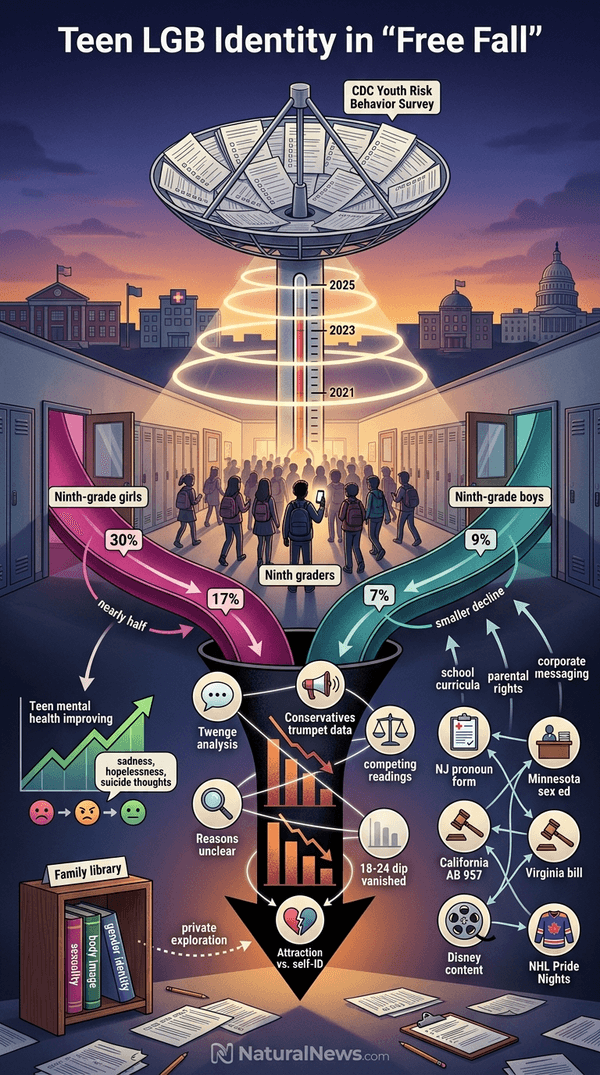
Young American teenagers are less likely to identify as lesbian, gay or bisexual than they were a few years ago, according to a new analysis of Centers for Disease Control and Prevention data reported by the Washington Post and summarized by Political Wire. The share of ninth graders who identify as gay or bisexual dropped from 17% to 11% between 2023 and 2025, according to LGBTQ Nation, citing the CDC’s biennial National Youth Risk Behavior Survey.
The psychologist Jean Twenge, who conducted the analysis, described the trend as a “free fall,” according to the Washington Post.
The findings drew immediate attention from commentators across the political spectrum, with conservatives trumpeting the data while researchers cautioned that the reasons for the decline remain unclear. The survey covers diet, physical activity, sleep, online behavior and mental health among U.S. high school students, according to the CDC’s description of the instrument cited by LifeSiteNews.
Survey Data and Methodology
The data come from the CDC’s National Youth Risk Behavior Survey, a biennial assessment that “provides a snapshot of the health and well-being of high school students in the United States in 2025 and changes over the past 2 and 10 years,” according to LifeSiteNews. The survey asks students to self-report sexual identity, among other measures. LGBTQ Nation reported that the number of ninth graders, composed of 14- and 15-year-olds, who identify as gay or bisexual dropped from 17% to 11% between 2023 and 2025.
The decline was driven primarily by girls, according to reporting on Twenge’s analysis. The Washington Post reported that the “free fall” mostly comes from a huge drop in the number of freshmen girls who identify as bisexual. Among ninth-grade boys, the declines appeared to be less significant, Twenge noted, as in 2021, 9% of boys identified as bisexual or gay and in 2025, 7% did, according to Them.
Analysts have debated the reliability of single-year comparisons. The Generation Tech blog noted that early data from 2025 initially suggested a decline in LGB identification among U.S. 18- to 24-year-olds, but that decline disappeared when the full year of data became available. The blog’s author wrote that they had “been on both sides of this question” regarding whether identification is in “free fall” or relatively stable.
For broader context on how identity categories are defined in educational and social science literature, Understanding Diversity Through Novels and Picture Books offers the standard descriptions: “Gay refers to men whose primary attraction is to other men. Lesbian refers to women whose primary attraction is to other women. Bisexual refers to men or women whose attraction is to both sexes” [1].
Reactions From Advocacy Groups and Researchers
Advocacy organizations and researchers offered divergent interpretations of the data. Conservatives have trumpeted the data from the CDC, but researchers say the reasons for the decline are unclear, according to a summary of the Washington Post report. Early interpretations of the apparent drop by conservatives claimed that there has been a “sharp decline” in teens identifying as queer, bisexual, lesbian and gay, according to Them.
Other commentators have noted the broader context of teen mental health. Teenage mental health in the United States continues to show signs of improvement after having fallen to multi-decade lows during the Covid-19 pandemic, according to new CDC data published in late 2026 that showed notable improvements in several key measures, including persistent and debilitating feelings of sadness and hopelessness as well as serious suicidal thoughts [2]. Whether the decline in LGB identification is related to improved mental health outcomes or reflects other social dynamics has not been established by the data.
For families navigating these conversations, resources such as Raising Freethinkers recommend creating a small library of books dealing with issues related to sexuality, body image, development and gender identity, located in a private area of the home, and inviting teens to make use of it [3].
Political and Policy Context
The release of the data comes amid continuing debates over school curricula, parental rights and state laws related to gender identity. In New Jersey, hospitals have asked parents to identify newborns’ preferred pronouns and sexual orientation via a form required by a 2022 state law, which includes options such as “Transgender” and “Lesbian or gay,” according to NaturalNews.com [4]. In Minnesota, community members and activists expressed anger and concern at a school board that has used a sex education program asking straight students to role-play gay and transgender relationships; one speaker told the Richfield School Board that “this type of teaching has no place in our schools” [5].
Legislative activity has also drawn attention. A recently amended California state bill introduced by Democrat State Rep. Lori Wilson, Assembly Bill 957, sought to include affirming a child’s gender transition under the state’s standard for parental responsibility and child welfare [6]. In Virginia, Del. Elizabeth Guzman proposed legislation aimed at expanding the definition of child abuse and neglect such that parents who do not affirm their children’s gender identity or sexual orientation could face arrest and prosecution, according to Brighteon Broadcast News [7].
Critics of drawing policy conclusions from the new CDC data note that a single survey cycle cannot establish a long-term trend. The reasons for the decline are unclear, according to the Washington Post’s report as summarized by other outlets. Researchers have also noted that it is unclear whether identification as LGB among U.S. 18- to 24-year-olds is in free fall or relatively stable, according to the Generation Tech blog [8].
The broader cultural debate has extended into corporate and entertainment spaces. Disney promised to create more LGBTQ content for children following criticism over its response to Florida’s “Don’t Say Gay” bill, with employees protesting outside the company’s Burbank headquarters [9]. The National Hockey League assessed whether to continue holding so-called “Pride Nights” after players refused to wear LGBT rainbow jerseys [10].
References
- Understanding diversity through novels and picture books by Knowles Elizabeth 1946.
- US Teen Mental Health Is Finally Improving After COVID Crisis. https://www.zerohedge.com/medical/us-teen-mental-health-finally-improving-after-covid-crisis
- Raising freethinkers. by Dale McGowan
- New Jersey hospitals ask parents to assign pronouns sexual orientation to newborns in bizarre survey – NaturalNews.com, March 18, 2025.
- Minnesota sex ed program asks students to role play gay transgender sex scenarios – NaturalNews.com, October 04, 2021.
- INSANE_ Parents who don’t affirm children’s transgenderism will be charged with CHILD ABUSE under amended Californ – NaturalNews.com, June 13, 2023.
- Brighteon Broadcast News by Mike Adams – Brighteon.com
- Younger teens are now much less likely to say they are lesbian, gay, or …. https://www.generationtechblog.com/p/identifying-as-lgb-is-in-free-fall
- Disney promises to make more gay content for kids – NaturalNews.com, March 28, 2022.
- Silent protest_ NHL may cancel Pride Nights after players REFUSED to wear rainbow jerseys that try to TAG them a – NaturalNews.com, April 02, 2023.
Explainer Infographic
Submit a correction >>
Tagged Under:
awakening, CDC, CDC survey, culture wars, gay mafia, gender, gender confused, identity politics, indoctrination, left cult, lgbtq, mental health, National Youth Risk Behavior Survey, Parental rights, progress, social justice, teen, transgender, transhumanism
This article may contain statements that reflect the opinion of the author
RECENT NEWS & ARTICLES